Meet an Elder: Mrs. Adeline Dickie
Mrs. Adeline Dickie was born at Fish Lake. She started sewing at the age of nine. She has sewn for sixty years. She still makes her own hide and has a craft store in her home. She does beautiful craft work with porcupine quills, beads, embroidery, moose hair, feathers, and wool.
|
Mrs. Dickie is seen here selling her crafts with her husband and daughter.
|
|
|
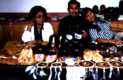
Photograph provided by Adeline Dickie
|
When asked on how color was added to quills and moose hair she explained:
To get dye for moose and quills we used pine cones which were boiled to get red dye. Tiny yellow flowers found in muskeg were also boiled for yellow dye. If black or white was needed porcupine quills were used. The quills would be cut up and sewn on. Depending on desired colour of moose hair you wanted, you would put ingredients into a pot to boil. Different colours of horse hair were also used for decoration around toe pieces of mocassins. Horse hair was sewn around toe piece like you use thread. There would be rows of different colours.

Photograph provided by Adeline Dickie. |
|
|
Birch bark baskets with beautiful quill work.
|
When asked about the different styles of mocassins, Mrs. Dickie explained:
The style of mocassin shown in the picture below was used until contact with the Inuit. This style was adapted after contact with Inuit.
|
The mocassins to the right are the type made before contact with the Inuit: those on the right after contact [click the image for a larger copy]
|
|
|
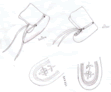
Drawing provided by Liz Burke
|

Drawing provided by Liz Burke |
|
|
If emergency foot wear was needed the hide from, a moose leg was removed, slit in the front and sewn onto a moccasin. [click the image for a larger copy]
|
Below are samples of Mrs. Dickies’ expert work.


