|
The Fort Nelson Aboriginal Project © copyright 1998 School District 81
Fort Nelson Aboriginal Project - Moose Tools |
Why might this be very dangerous? back to moose page . . .
The metal part of the scraper is usually about 3 cm. wide and 19 cm long. It is placed into hot coals until red hot and then pounded with a hammer or a heavy object to bend to a curve on each end. The edge of the curves would be filed to a very sharp blade which is used for scrapping moose hair off its hide. The center of scraper is then wrapped with cloth to make it easier to hold onto when scraping. After all the hair is taken off the inner white flesh which is scraped off could be eaten.
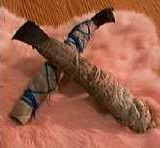
Metal moosehide scraper, made by Edward Needlay

Photograph provided by Raymond and Wanda Needlay.
Bone flesher, made by Edward Needlay.
To make this tool, Front leg of a moose bone is broken or cut with a saw at a length of 30 cm. It is then filed to an angled julian cut. Cloth is then wrapped around the middle of bone and up around the top and back down to center, leaving a loop around the center of the bone for a hand rest. The loop is needed for your hand to rest in when pounding the sharp edge against the hide to take the flesh off. The flesh can also be eaten. The flesh is cleaned and cut into shapes of about 60 cm. long and 30 cm wide and hung up on racks to dry. It makes an excellent meal when baked in an oven for 15 min.
Finishing scraper for softening hide - ttheete.
To create this tool a long tree with no limbs is cut at a length of 90 to 100 cm. and a circumference of 18 cm. The bark is taken off. With a knife, the post is carved to a smooth texture. It is split at one end so that the rock or scrapper can be fitted in and fastened. A perfect thin oval rock has to be found.
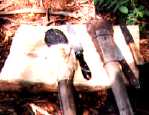
Moosehide Softener made by the Dickie Family.
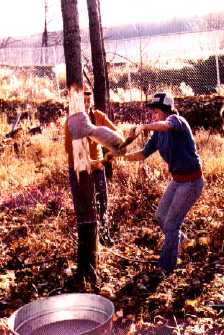
Photograph provided by the Kelly Lake First Nation.
-meh nahts’idege’hdhi
To wring out the hide you need two posts. The first post is pounded into the ground solidly. The hide already has holes around the edges. Using these holes the hide is attached onto the post. The other stick is attached on the opposite end of the hide. The loose stick is twisted around until it is as tight as it can get. The stick is secured tight so it doesn’t spring back. It can be left for about 10-15 minutes. This procedure is repeated (probably three times) until it is stretched and dried.
The winding stick could do serious damage if a hand lost its grip and the tightly wound hide began to unwind suddenly.